How to find the best nights for astrophotography
The five signals that actually decide a good night — and how to read them in minutes, not hours.
Read the guideAstrophotography planner · iOS & Android
Dark Skies helps photographers decide when tonight is worth shooting — with Best Nights, Milky Way windows, Moon visibility, meteor outlooks, weather forecasts, widgets, alerts and exposure tools. No ads. No accounts required.
Free to download No account No ads
Built for night-sky photographers — by people who chase the dark.
Know before you pack the bag
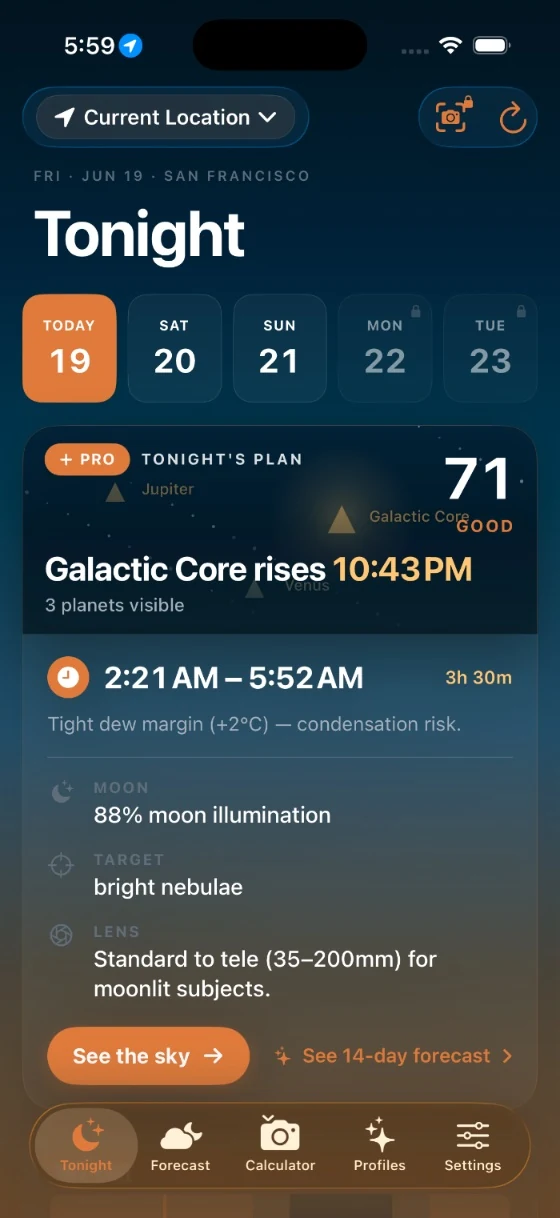
Every clear-looking night isn't a good one. Dark Skies reads cloud cover, atmospheric transparency, humidity, moonlight and your true dark hours, then gives you one honest answer — a Night Score from 0 to 100.
Stop cross-referencing five weather sites. The Night Score blends every signal that matters into a single, glanceable read.
See exactly when the sky goes properly dark — after the moon sets, before dawn, while your target is high.
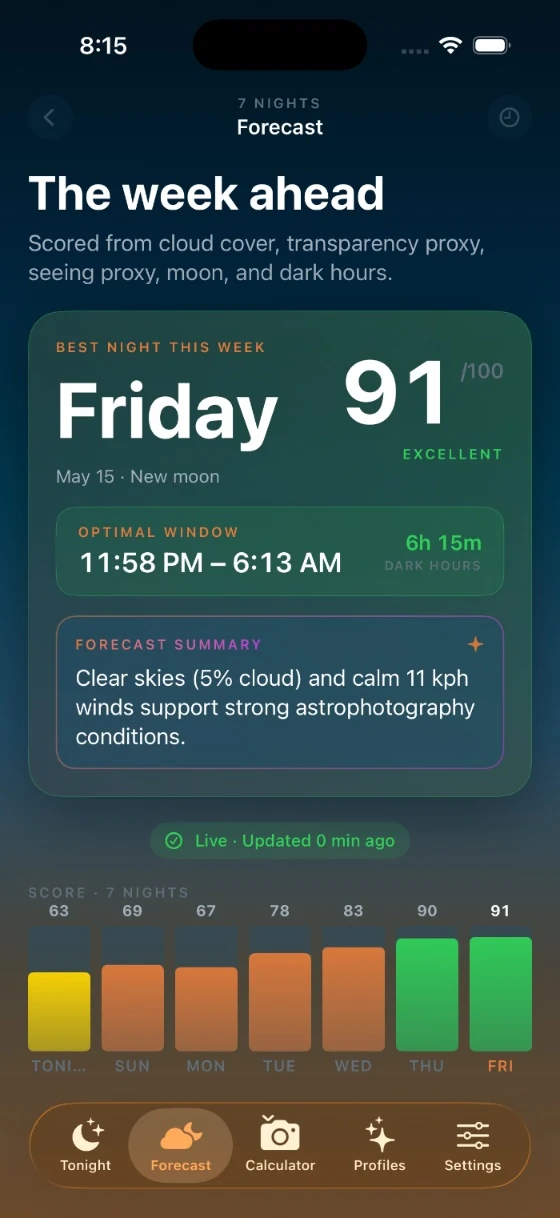
A 14-day outlook surfaces the best upcoming nights so you can book the drive and the babysitter in advance.
A planner, end to end
Scroll through the night the way the app walks you through it — from picking the night, to catching the Milky Way, to dialing in the exposure.
Dark Skies scores the next two weeks on cloud cover, transparency, moon phase and dark hours — then tells you, plainly, which night to shoot.
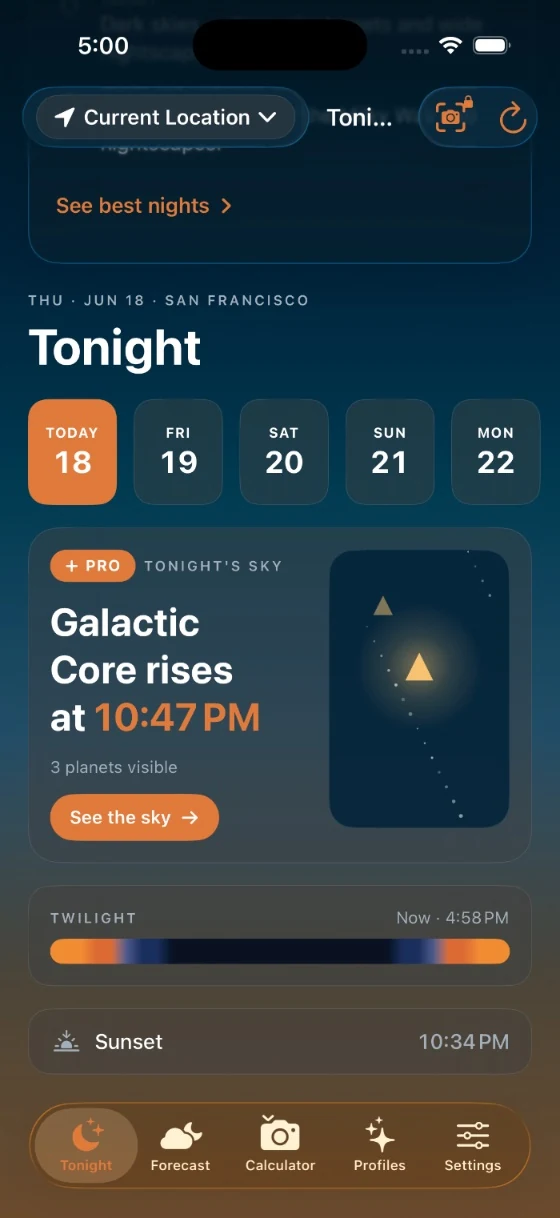
Know precisely when the Milky Way core clears the horizon, how high it climbs, and how long it stays visible in true darkness — for any night, any location.
Moonlight is the quiet killer of deep-sky shots. Dark Skies shows phase, illumination and the exact rise/set times, plus a meteor-shower outlook with peak nights and expected rates.
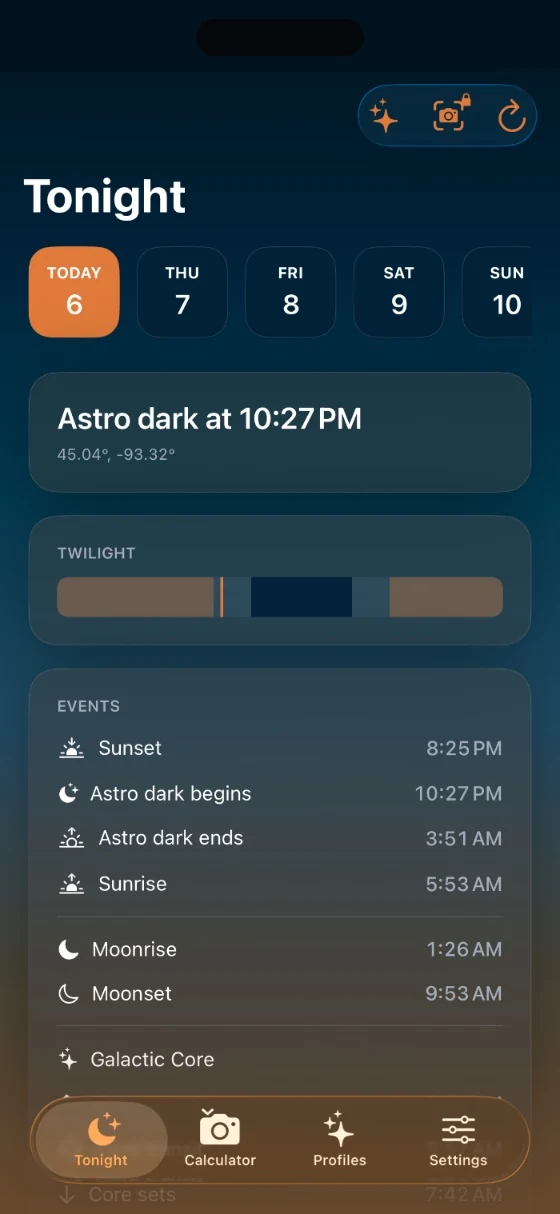
Not “20% chance of rain.” Dark Skies reads cloud cover by hour, transparency and humidity, dew-point margin and the genuinely dark hours — so you know exactly when to be set up.
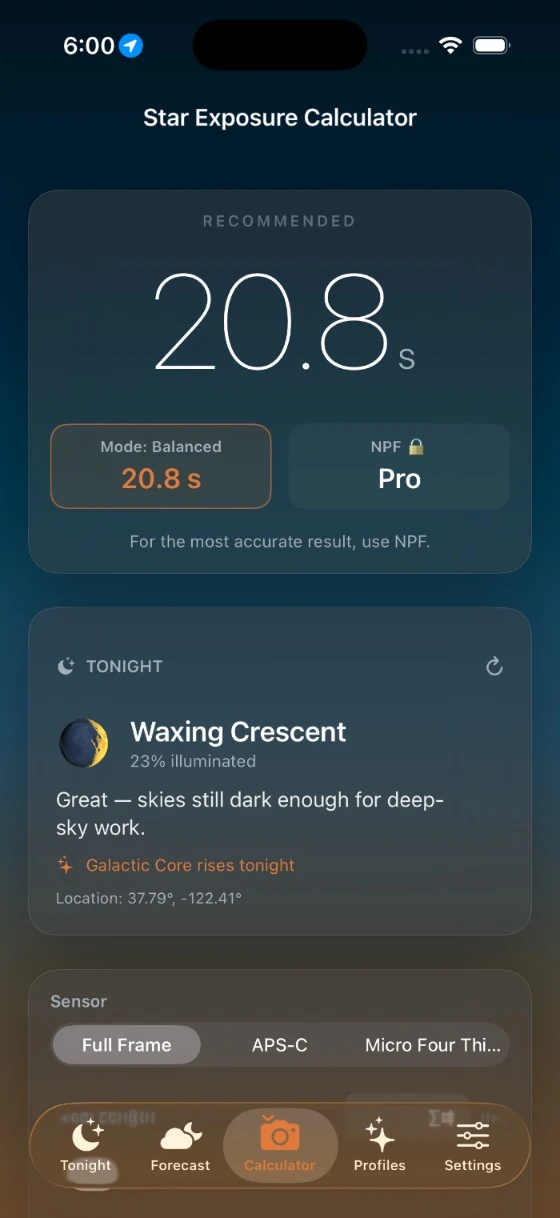
The Star Exposure Calculator turns your camera, lens and sky into a recommended shutter speed — Balanced or Sharper — so you nail focus and tracking without the guesswork.
How Dark Skies works
Use your current location or save the dark-sky sites you shoot. No sign-up — it just works.
One number tells you if tonight's worth it, with the dark window and what's visible underneath.
Get your exposure from the calculator and the best window for the Milky Way, moon or meteors.
Add widgets and smart alerts so a great upcoming night finds you — no need to keep checking.
Everything in the bag
A single 0–100 read on whether tonight is worth shooting.
A 14-day ranked outlook of the clearest, darkest nights ahead.
Galactic-core rise, peak and set times for any night and place.
Phase, illumination and rise/set so moonlight never surprises you.
Shower peaks, radiant timing and expected rates per night.
Cloud, transparency, dew-point and wind by the hour.
Balanced and Sharper (NPF) shutter speeds for your kit.
Tonight's score and dark window on your Home and Lock screens.
A heads-up when an exceptional night is coming to your spot.
Privacy-first by design
Dark Skies is built to be useful and trustworthy — not to harvest you. There's nothing to sign up for and nothing to sell.
Read the privacy policyOpen the app and start planning. No email, no password, no profile.
No banners and no ad networks. Diagnostics are optional, privacy-respecting, and off by default.
Saved Locations stay on your device. Forecasts use your location only to calculate sky and weather conditions — never to track you.
Saved plans and recent forecasts are available when you arrive, even with patchy signal.
Learn the night sky
The five signals that actually decide a good night — and how to read them in minutes, not hours.
Read the guideWhen the galactic core is visible from your latitude, and how to time the window around the moon.
Read the guideWhy illumination beats phase, and how to use moonrise and moonset to protect your deep-sky frames.
Read the guideBefore you head out
The bright Galactic Core is seasonal. From the northern hemisphere it's visible roughly February to October, and only for part of the night — rise, peak and set times shift with your latitude and the date. Dark Skies shows the exact core window for your location on any night.
Five signals decide it: low cloud cover, good atmospheric transparency, low humidity, little or no moonlight, and enough true astronomical darkness while your target is high. A night can look clear and still fail on moonlight or haze — which is why it pays to read a forecast built for photographers.
The 500 rule is a quick estimate of the longest shutter speed before stars trail: 500 divided by your effective focal length. The NPF rule is a more precise version that also accounts for aperture and pixel pitch. Dark Skies' exposure calculator gives Balanced and Sharper (NPF) recommendations for your camera and lens.
The Night Score blends cloud cover, atmospheric transparency, humidity, moonlight and your true dark hours into a single 0–100 read for your location. It's a forecast, not a promise — its job is to tell you honestly which nights are worth the drive.
The astronomy — Milky Way, Moon and dark-window timing — is calculated on your device, so it works without signal. Weather forecasts need a connection to fetch, though recently loaded forecasts and saved plans stay available in the field.
No account, ever — open the app and start planning. There are no ads, and your location is used only to calculate sky and weather conditions for your spot. Optional diagnostics exist to help us fix crashes, and they're off by default. The privacy policy has the details.
Dark Skies is free to download and fully usable on its own. An optional Pro subscription unlocks the app's advanced planning features, billed through the App Store or Google Play, where you can manage or cancel any time.
The next clear night is coming
Download Dark Skies and plan your next shoot in under a minute. Free to start. No ads. No accounts.
Free to download No account No ads
iOS 18.1+Android 12+

